Case Study 03

Preventing roll-aways

Redesigned Amazon's vehicle safety system to use real-time signals — replacing passive reminders with an active intervention that eliminated roll-away incidents.

Role
Lead Product Designer
Company
Amazon
Type
Vehicle Safety
Illustration of an Amazon delivery van rolling down a hill

A reminder isn't the same as a fix

Roll-aways — vehicles moving on their own after a driver exits — are one of the most dangerous events in fleet operations. The fleet already had an At Stop Notification on the driver's phone: after a safety event, the driver would see a reminder to use their parking brake, confirm they read it, and move on.

My PM's proposal was to bring this same pattern to the in-vehicle tablet — a real-time version of the same acknowledge-and-dismiss flow. I tested the approach, but the fundamental problem remained: the driver could tap through the reminder while the vehicle was still parked unsafely. A notification someone acknowledges isn't an intervention — it's a checkbox. The van doesn't care if you read the message.
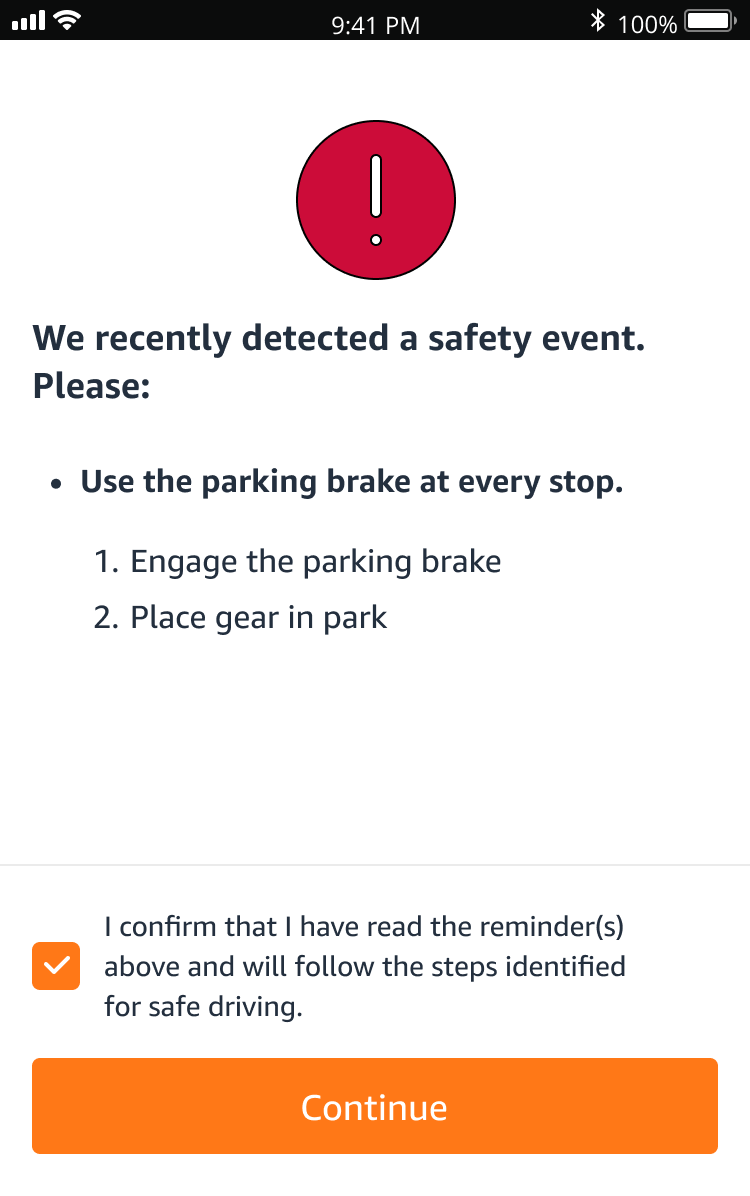
Existing — phone
At Stop Notification on phone — safety event detected, reminder to use parking brake
The existing At Stop Notification on the driver's phone: a post-event reminder they read and acknowledge.
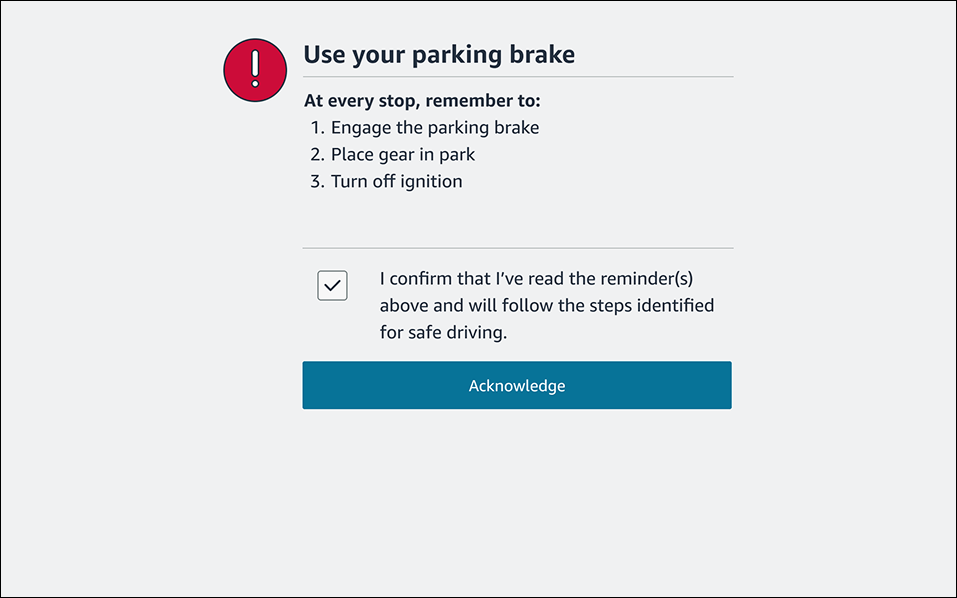
The ask — tablet
At Stop Notification on tablet — use your parking brake reminder
The PM's proposal: bring the same acknowledge-and-dismiss pattern to the in-vehicle tablet. Same problem — no verification the vehicle is actually safe.

Using vehicle signals to coach drivers into safer behavior

After testing the proposed reminder approach, I pushed the concept further. Working closely with the hardware engineering team, I designed a system that reads real-time signals from the vehicle itself — parking brake status and gear position — and surfaces a visual that reflects the actual state. Instead of asking drivers to acknowledge a notification, the system soft-blocks them until the vehicle is genuinely safe: brake applied, gear in park. The collaboration with hardware was critical — we had to identify which vehicle signals were reliable enough to build an intervention on, and how to read them consistently across different van models in the fleet.

Each safety condition appears as a card with clear red/green status. When both conditions are met, the alert drops away on its own. The driver doesn't dismiss anything — the vehicle does. This shifts the interaction from "I read this" to "I actually did this."

A bypass option ("Press and hold to confirm") handles edge cases where sensors report a false signal, keeping drivers from getting stuck. But the friction is intentional — using the bypass takes more time and effort than simply parking safely. The path of least resistance is the right one.

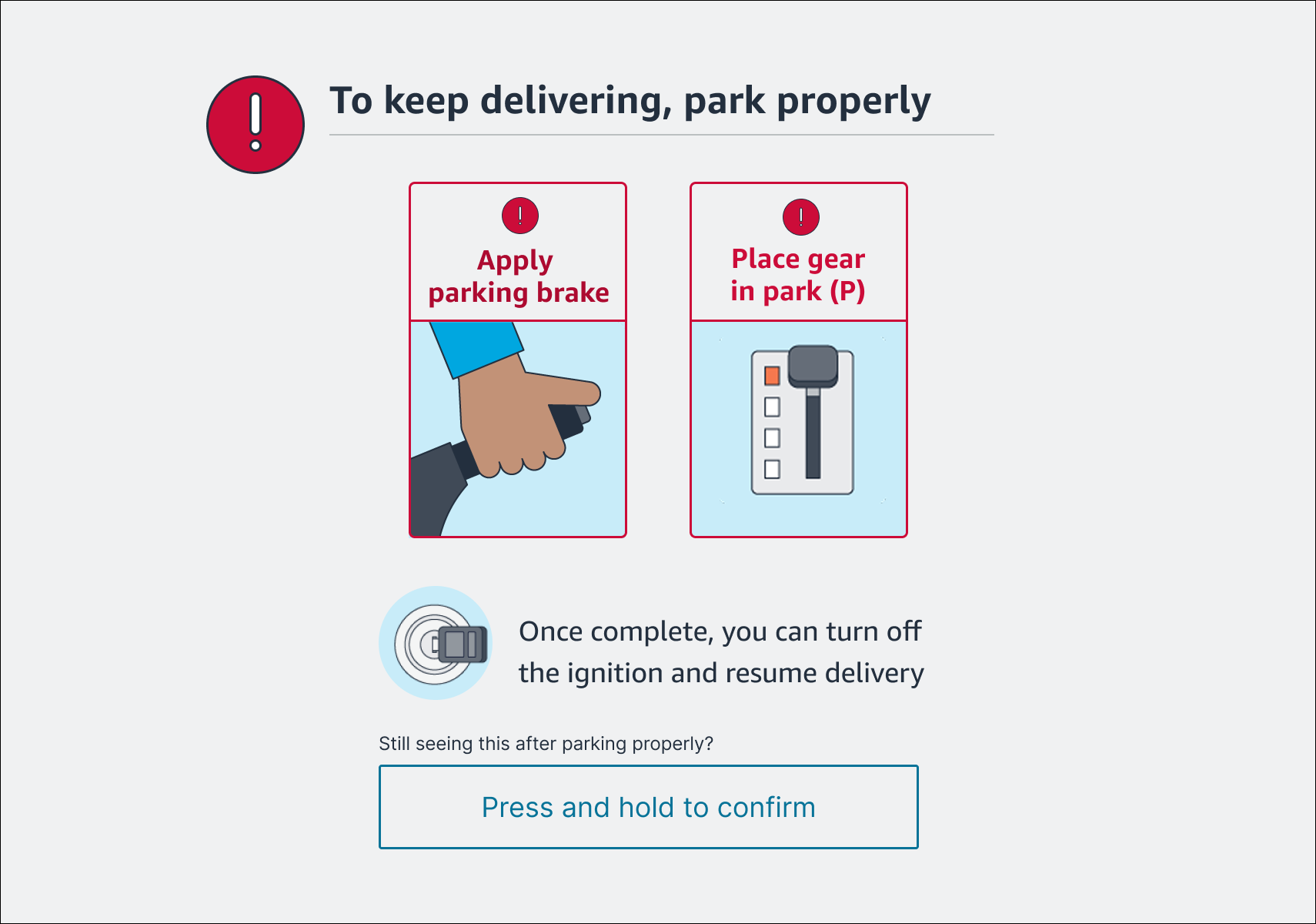
Both conditions unmet
Tablet warning: neither parking brake nor gear in park — both red
Neither condition is met — both cards show red. The driver can't continue until both are resolved.
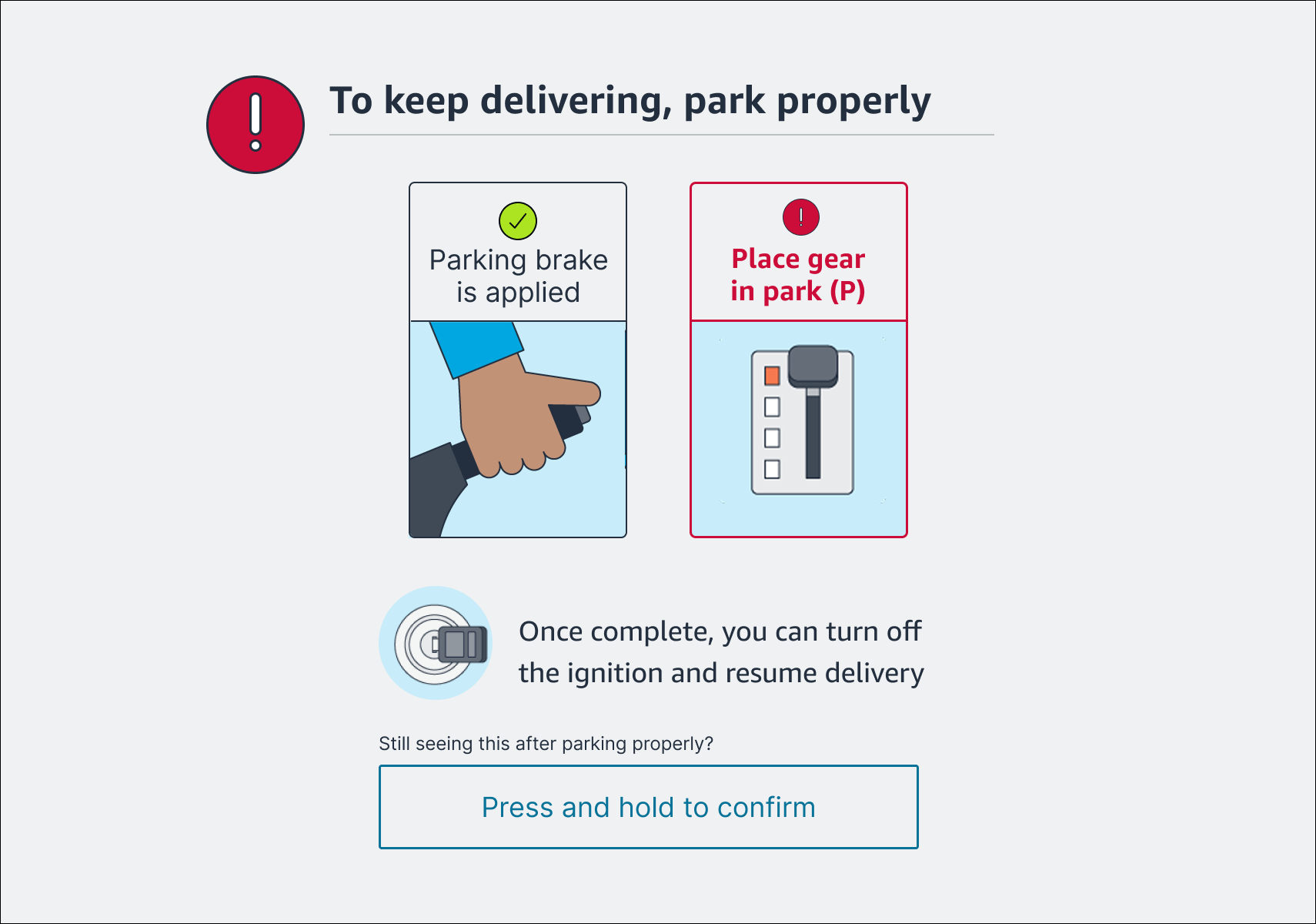
Brake applied, gear still out
Tablet warning: parking brake applied (green), gear not in park (red)
Parking brake is applied (green), but gear isn't in park (red). Real-time feedback shows exactly what's left to do.

Designing for two surfaces at once

The intervention needed to work on both surfaces: the in-vehicle tablet and the driver's phone. The tablet catches the issue at the moment of parking. But the phone is just as critical — once a driver steps out to complete a delivery, they need to take the phone with them. If the vehicle isn't safely parked, the phone becomes a soft block: the driver can't move on to their next task without addressing the parking issue first. Same core layout on both — headline, status cards, bypass action — adapted for each form factor.

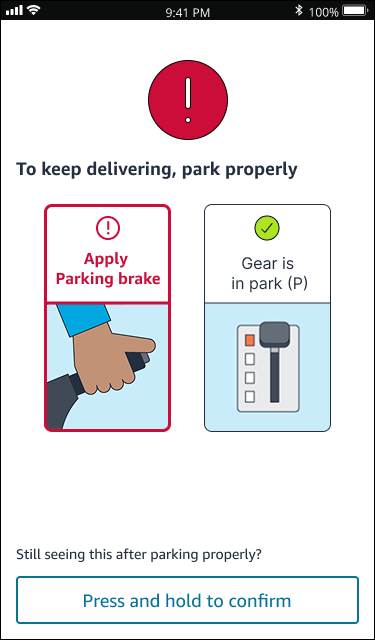
Phone
Phone version — parking brake not applied, gear in park
Phone: a soft block to delivery. The driver can't move on to their next stop without addressing the parking issue first.
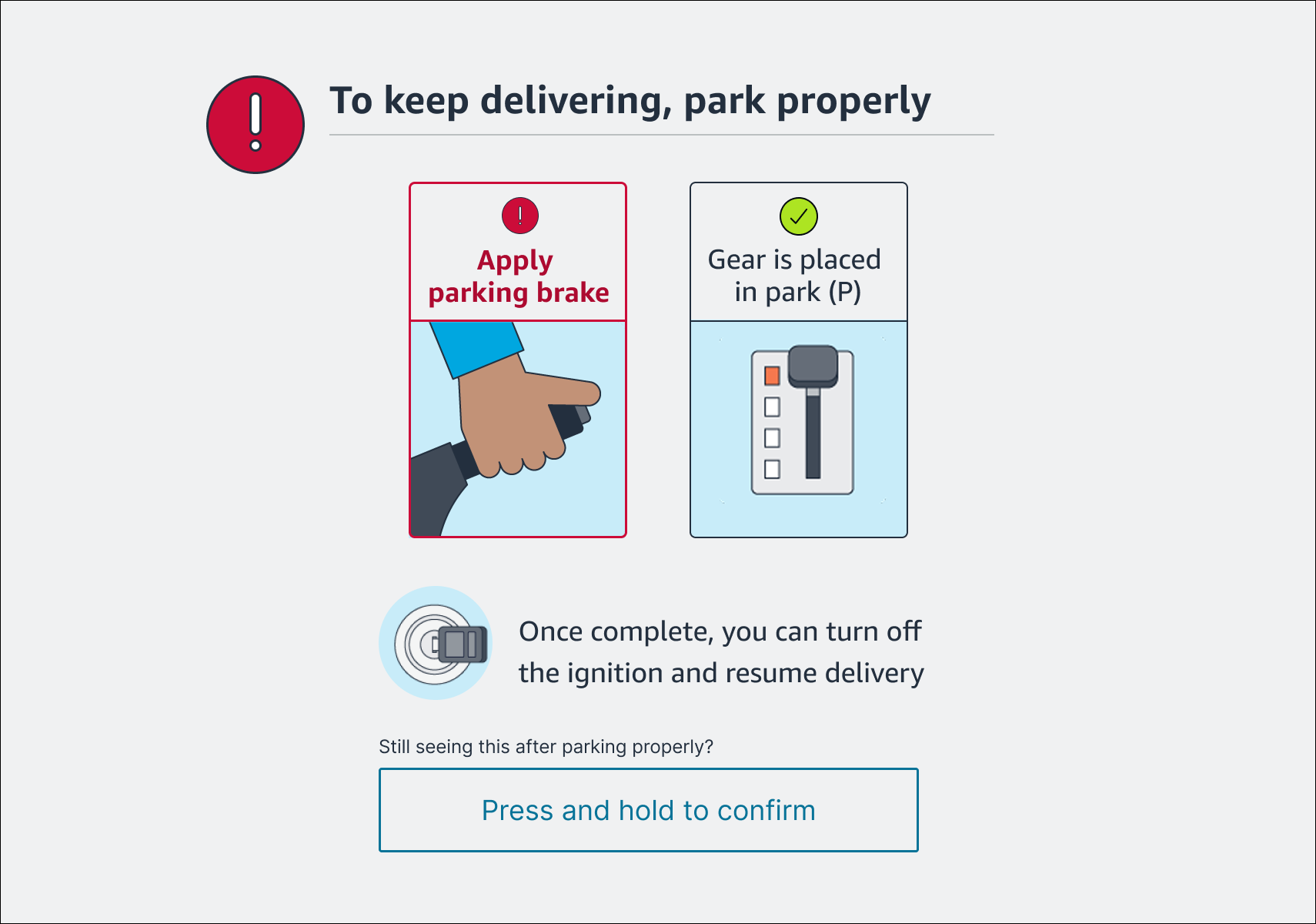
Tablet
Tablet version — parking brake not applied, gear in park
Tablet: denser layout, designed for dash-mounted scanning. Same information hierarchy, adapted for landscape.
The driver doesn't dismiss the warning — the vehicle does.

Zero roll-aways

0
Roll-away incidents with the system enabled
94.5%
Parking brake compliance, up from 23%
8/9
Drivers found the tool useful

By tying the safety intervention to real-time vehicle signals rather than driver acknowledgment, compliance shifted from roughly one in four drivers to nearly all of them. The system's success extended beyond the immediate safety metric — it influenced broader operational decisions around fleet standards and vehicle procurement priorities.

The deliberate friction in the bypass flow proved critical: making drivers press and hold (rather than tap) reduced false dismissals while still providing an escape hatch for genuine sensor errors. The design balanced safety with trust — drivers weren't locked out, but they couldn't sleepwalk through it either.

Next Project